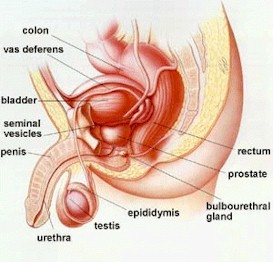
The prostate (from the Greek protector - PROSTATES, literally, is imminent "," protector "," guardian "[1]) is a complex tubuloalveolar apocrine sweat glands of the male reproductive system of mammals. Women have no breadwinner, although women have microscopic Skene-paraurethral glands in the distal third of the urethra in prevaginal space, similar to the prostate. The main function of the prostate is to store and secrete a clear, slightly alkaline (pH 7.29) liquid, 10-30% of the volume of liquid catalyst, together with sperm, making it the seeds. The remainder of the fluid catalytic represented by the two catalytic vesicle. The alkalinity of the fluid catalytic helps neutralize the acid vaginal route, extending the life of spermatozoa. prostate hyperplasia part of the urethra developed the pool (middle) Urogenital part of the bay (endodermal origin). Endodermalen outgrowths resulting from prostate hyperplasia part of the urethra and grow into the surrounding mesenchyme. The epithelium of prostate glands differ from those endodermal cells and the associated mesenchyme differs in the dense stroma cells and smooth muscle of the prostate. [2] The prostate gland, the modified wall of the near part of the male urethra and caused from 9 Week embryonic life in the development of the reproductive system. condensation mesenchyme, urethra and Wolffian channels creates the adult prostate, a composite of several organs, glands and non-glandular ingredients closely merged into a single capsule. Within the prostate, bladder from the urethra urethra is the hyperplasia and merged with two channels ejaculatory. (The male urethra has two functions: the transfer of urine from the bladder during urination and to carry semen during ejaculation.) The prostate is the mantle of the pelvic floor muscles in ejaculatory contract during the process. benign prostatic hyperplasia (BPH) occurs in elderly men, [6] enlarged prostate often to the point where urination is difficult. The symptoms often include toilet (pollakisuria) or take a while to get started (hesitation). If the prostate is growing too large, may constrict the urethra and prevent the flow of urine, making it difficult and painful urination and, in extreme cases, impossible. BPH can be treated with medication, minimally invasive procedure or, in extreme cases, surgery that removes the prostate. minimally invasive procedures include Transurethral needle ablation of the prostate (tuna) and Transurethral microwave thermotherapy (TUMT). external This procedure can be followed by integrating a temporary prostatic stent both normal voluntary urination, and there are no irritant symptoms worsen. [7] The most commonly used in surgery such cases are called transurethral resection of the prostate (TURP or TUR). TURP, which is an instrument inserted through the urethra to remove prostate tissue, is pressing against the upper part of the urethra and restricting the flow of urine. Older men often have Corpora amylacea [8] (amyloid), dense accumulations verkalkte protein material on the lines PROSTATES. Corporation amylacea may hinder the lumen of prostate hyperplasia channels and can build several cases of BPH. Prostate cancer is one of the most common forms of cancer, older men in developed countries and a major cause of death for older men (estimated by some experts to 3%). rectal regular examinations are recommended for older men to early detection of prostate cancer. In 1993, the journal of the American Medical Association found a link between vasectomy and an increased risk for prostate cancer. Reported studies of 48000 and 29000 men who had vasectomies showed 66 percent and 56 percent higher prostate cancer, respectively. The risk increases with age and the number of years after the vasectomy done. But in March of that year, the National Institute of Child Health and Human Development held a conference cosponsored by the National Cancer Institute and others to review the available data and information on the relationship between prostate cancer and vasectomies. It was found that the relationship between the two was very weak at best, even if a vasectomy increases the risk, the risk was relatively small. Recent scientific discoveries mean prostate with stent is a viable way un - blocked the prostate. stents are devices inserted into the urethra to expand and keep open. Stents can be temporary or permanent and are usually outpatient basis under local anesthesia or spinal cord and usually lasts around 30 minutes.


