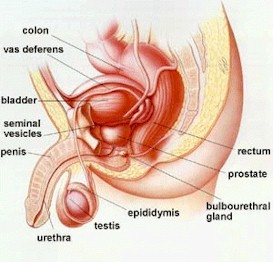
The prostate (from the Greek protector - PROSTATES, literally, is imminent "," protector "," guardian "[1]) is a complex tubuloalveolar apocrine sweat glands of the male reproductive system of mammals. Women have no breadwinner, although women have microscopic Skene-paraurethral glands in the distal third of the urethra in prevaginal space, similar to the prostate. The main function of the prostate is to store and secrete a clear, slightly alkaline (pH 7.29) liquid, 10-30% of the volume of liquid catalyst, together with sperm, making it the seeds. The remainder of the fluid catalytic represented by the two catalytic vesicle. The alkalinity of the fluid catalytic helps neutralize the acid vaginal route, extending the life of spermatozoa. prostate hyperplasia part of the urethra developed the pool (middle) Urogenital part of the bay (endodermal origin). Endodermalen outgrowths resulting from prostate hyperplasia part of the urethra and grow into the surrounding mesenchyme. The epithelium of prostate glands differ from those endodermal cells and the associated mesenchyme differs in the dense stroma cells and smooth muscle of the prostate. [2] The prostate gland, the modified wall of the near part of the male urethra and caused from 9 Week embryonic life in the development of the reproductive system. condensation mesenchyme, urethra and Wolffian channels creates the adult prostate, a composite of several organs, glands and non-glandular ingredients closely merged into a single capsule. Within the prostate, bladder from the urethra urethra is the hyperplasia and merged with two channels ejaculatory. (The male urethra has two functions: the transfer of urine from the bladder during urination and to carry semen during ejaculation.) The prostate is the mantle of the pelvic floor muscles in ejaculatory contract during the process. benign prostatic hyperplasia (BPH) occurs in elderly men, [6] enlarged prostate often to the point where urination is difficult. The symptoms often include toilet (pollakisuria) or take a while to get started (hesitation). If the prostate is growing too large, may constrict the urethra and prevent the flow of urine, making it difficult and painful urination and, in extreme cases, impossible. BPH can be treated with medication, minimally invasive procedure or, in extreme cases, surgery that removes the prostate. minimally invasive procedures include Transurethral needle ablation of the prostate (tuna) and Transurethral microwave thermotherapy (TUMT). external This procedure can be followed by integrating a temporary prostatic stent both normal voluntary urination, and there are no irritant symptoms worsen. [7] The most commonly used in surgery such cases are called transurethral resection of the prostate (TURP or TUR). TURP, which is an instrument inserted through the urethra to remove prostate tissue, is pressing against the upper part of the urethra and restricting the flow of urine. Older men often have Corpora amylacea [8] (amyloid), dense accumulations verkalkte protein material on the lines PROSTATES. Corporation amylacea may hinder the lumen of prostate hyperplasia channels and can build several cases of BPH. Prostate cancer is one of the most common forms of cancer, older men in developed countries and a major cause of death for older men (estimated by some experts to 3%). rectal regular examinations are recommended for older men to early detection of prostate cancer. In 1993, the journal of the American Medical Association found a link between vasectomy and an increased risk for prostate cancer. Reported studies of 48000 and 29000 men who had vasectomies showed 66 percent and 56 percent higher prostate cancer, respectively. The risk increases with age and the number of years after the vasectomy done. But in March of that year, the National Institute of Child Health and Human Development held a conference cosponsored by the National Cancer Institute and others to review the available data and information on the relationship between prostate cancer and vasectomies. It was found that the relationship between the two was very weak at best, even if a vasectomy increases the risk, the risk was relatively small. Recent scientific discoveries mean prostate with stent is a viable way un - blocked the prostate. stents are devices inserted into the urethra to expand and keep open. Stents can be temporary or permanent and are usually outpatient basis under local anesthesia or spinal cord and usually lasts around 30 minutes.
In professional settings massage involves the client being treated while lying on a massage table, sitting upright in a massage chair, or lying on a mat on the floor. The massage may be subject fully or partially unclothed and body covered with towels or sheets. Specialized massage tables and chairs are used to position customers during massages. A typical commercial massage table has an easily cleaned, heavily padded surface, and a horseshoe-shaped head support that allows the client to breathe easily, while lying face down and can be fixed or portable. An orthopedic pillow or reinforce can be used to correct body positioning. Chairs ergonomic serve a function similar to a massage table. Chairs can be stationary or portable models. Massage chairs are easier for the operator to carry massage tables and customers do not need to disrobe to receive a chair massage. Because of these two factors, chair massage is often performed in settings such as corporate offices, outdoor festivals, shopping malls and other public places. Different types of oils can be used fractionated including coconut oil, oil seeds of grapes, Macadamia oil, sesame oil, pecan oil, oil and mustard. Arnica, from the flowers or leaves Arnica montana, may be added olive oil when used with medicines, almond oil or when used as a massage oil. [13] Aromatherapy oils as neroli oil and pine oil can also be mixed with oils carrier. Ayurveda is a natural health care system originating in India that incorporates massage, yoga, meditation and herbal remedies. Ayurvedic massage, also known as Abhyanga is usually performed by one or two therapists heated with a mixture of vegetable oils based on Ayurvedic system of moods. Myofascial release refers to the manual massage technique for the band stretching and releasing the bonds between band, integument, muscles and with the aim to eliminate pain, increase range of motion and equilibrioception. Myofascial release usually involves the application shear compression and tension in various directions, or skin rolling. Watsu is the combination of hydrotherapy and shiatsu developed by Harold opaque. The work is done in skin temperature water with both the therapist and doctor in water, usually a pool which is between 3.5 but 4 feet (100-120 cm) deep. The work entails much movement in water and they assume that it incorporates the activation of lines of energy derived from shiatsu. Peer-reviewed medical research has shown that the benefits of massage include pain, stretch reduced anxiety and depression, and temporarily reduced blood pressure, heart rate, anxiety and the state. [19] theories behind what could be done massages include blocking nociception (gate control theory), activating the parasympathetic nervous system that can stimulate the release of endorphins and serotonin, preventing fibrosis or scar tissue, increasing the flow of sap, and improve sleep [5], but such effects are yet to be supported by well-designed clinical trials. United States of America in licensure is the highest level of regulation and this limits anyone without a license to practice massage therapy or by calling themselves that protected title. Certification allows only those who meet certain educational criteria to use the protected name and registration takes just a list of therapists who apply and meet an educational requirement. [34] They state that people who use the massage because they believe that relieves pain from musculoskeletal injuries and other causes of pain, reduces stress and improves relaxation, rehabilitation sports injuries, decreases the feeling of anxiety and depression, and increases the general welfare. [5] Heinrich Himmler, commander of the Schutzstaffel (SS) and one of the most powerful men in Nazi Germany may have lost their faith in German victory because of his discussions with his masseurs Felix Kersten and Walter Schellenberg. [38] Albert Bedane (1893-1980) provided refuge to a Jewish woman and others during the Second World War was a massage / physiotherapist. Athletics audiology • • • Bioengineering Biomedical Sciences Chiropractic • • • dental hygiene Dietetics electrocardiogram technicians • • emergency medical services technicians haemodialysis • • • massage therapy medical assistants medical physics • • • Medical technologist medical transcription • • Music therapy nuclear medicine technology • Nutrition • Occupational Therapy Optometry • • Phlebotomy • Orthotics / Prosthetics physiotherapy • • • Podiatry Psychology Radiotherapy • • • Radiography radiological technologist respiratory therapy • • • Speech therapy social work • Ultrasound
Language, question the function of language is used in the information statement ends. Words are doubts as to wh - also for the words, most English words starting WH - question. In English, they are the questions (Where is he?) And questions about the content section (where is he?) The form in a certain relative clause (in each country born) and certain adverbial phrase (it) . These are all in use in various other languages.
In linguistics, an auxiliary (also called helping verb, helper verb, auxiliary verb, or verbal auxiliary) is a verb functioning to give further semantic or syntactic information about the main or full verb following it. In English, the extra meaning an auxiliary verb imparts alters the basic form of the main verb to have one or more of the following functions: passive, progressive, perfect, modal, or dummy. In English, every clause has a finite verb which consists of a full verb (a non-auxiliary verb) and optionally one or more auxiliary verbs, each of which is a separate word. Examples of finite verbs include write (no auxiliary verb), have written (one auxiliary verb), and have been written (two auxiliary verbs). There is a syntactic difference between an auxiliary verb and a full verb; that is, each has a different grammatical function within the sentence. In English, and in many other languages, there are some verbs that can act either as auxiliary or as full verbs, such as be ("I am writing a letter" vs "I am a postman") and have ("I have written a letter" vs "I have a letter"). In the case of be, it is sometimes ambiguous whether it is auxiliary or not; for example, "The ice cream was melted" could mean either "Someone/something melted the ice cream" (in which case melt would be the main verb) or "the ice cream was mostly liquid" (in which case be would be the main verb). The auxiliary verb be is used with a past participle to form the passive voice; for example, the clause "the door was opened" implies that someone (or something) opened it, without stating who (or what) it was. Because many past participles are also stative adjectives, the passive voice can sometimes be ambiguous; for example, "at 8:25, the window was closed" can be a passive-voice sentence meaning "at 8:25, someone closed the window," or a non-passive-voice sentence meaning "at 8:25, the window was not open". Perhaps due to this ambiguity, the verb get will sometimes be used colloquially instead of be in forming the passive voice, "at 8:25, the window got closed". The auxiliary verb be is used with a present participle to form the progressive aspect; for example, the sentence "I am riding my bicycle" describes what the speaker is doing at the very moment of utterance, while the sentence "I ride my bicycle" is a temporally broader statement. The auxiliary verb have is used with a past participle to form the perfect aspect; for example, the sentence "Peter has fallen in love" differs from "Peter fell in love" in that the former implies some connection to the present — likely that Peter is still in love — while the latter does not. There are nine modal verbs: can, could, may, might, shall, should, will, would, and must. They differ from the other auxiliaries both in that they are defective verbs, and in that they can never function as main verbs. (There do exist main verbs can and will, but these are distinct.) They express the speaker's (or listener's) judgement or opinion at the moment of speaking. Some of the modal verbs have been seen as a conditional tense form in English. In American English, go and come can be quasi-auxiliaries with nothing between them and the following verb phrases, but only in their plain forms: "Come show me", "I'll go get it", and "I had to come see for myself". This use can be regarded as ellipsis of and — the previous are equivalent to "Come and show me", "I'll go and get it", and "I had to come and see for myself" — and British English requires the and to be included, as does American English when the verb is not in its plain form: "I went and saw him." (It is also possible in both dialects for to to be used in place of and, though this typically has a slightly different sense.) Auxiliaries take not (or n't) to form the negative, e.g. can't, won't, shouldn't, etc. In certain tenses, in questions, when a contracted auxiliary verb can be used, the position of the negative particle n't moves from the main verb to the auxiliary: cf. Does it not work? and Doesn't it work? Auxiliaries can be repeated at the end of a sentence, with negation added or removed, to form a tag question. In the event that the sentence did not use an auxiliary verb, a dummy auxiliary (a form of do) is used instead: